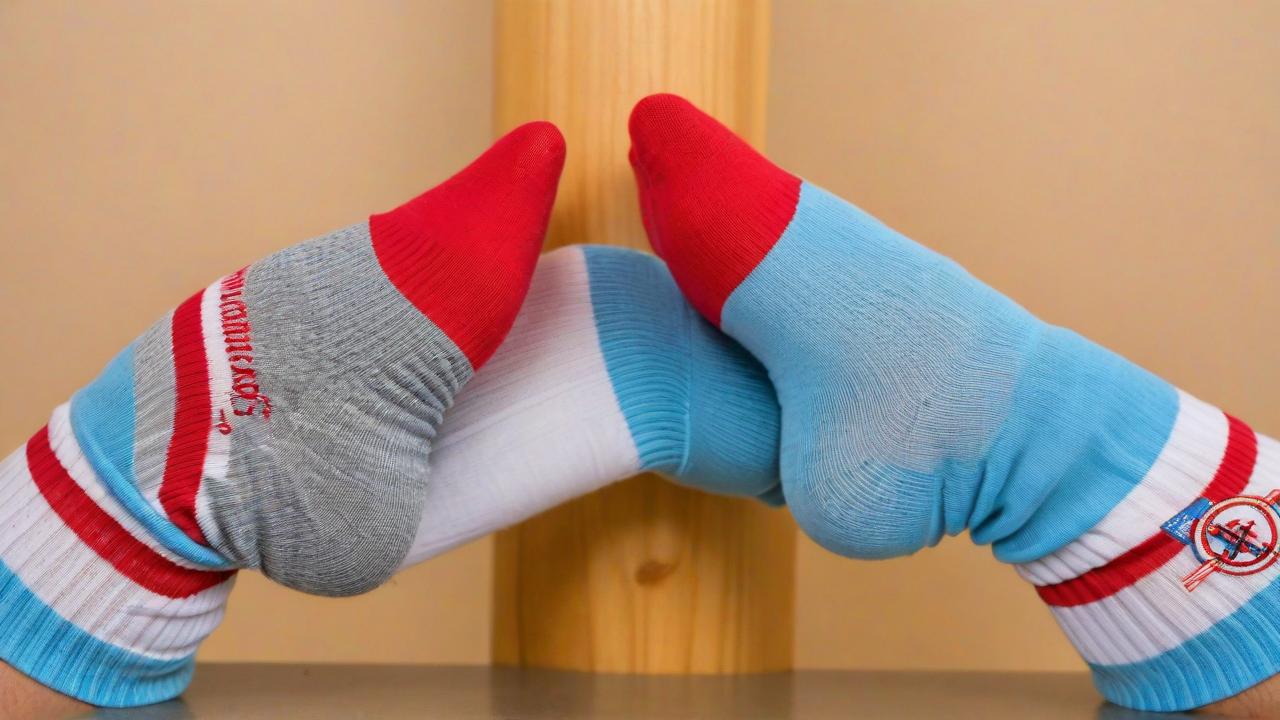
The Economics of Subconscious Sock Pairing Anomalies and Their Potential Implications on Modern Society's Perceived Reality
When one stops to consider, a most peculiar phenomenon has been occurring in the realm of modern society. It appears that our subconscious minds have developed an affinity for matching socks, a trait that transcends the mundane confines of reality itself. But why? And what does this peculiar anomaly portend for our collective understanding of the world?
Let us begin by examining the concept of Sock Pairing – a term I shall use to describe the phenomenon in question. It is here that we find a most interesting aspect: people, seemingly unconsciously, always seek to match their socks when they are paired. This applies not just to individuals, but to those who wear matching socks, regardless of cultural background or socioeconomic status.
Now, one might argue that this is merely the result of habituation – an extension of our natural inclination towards order and symmetry in life's details. But I propose that there be more at play here than simply a quirk of human nature. No, I believe that Sock Pairing is a manifestation of something much more profound – an underlying economic principle that governs the fundamental fabric of our reality.
Consider this: when we purchase socks, we are not merely buying a product; we are purchasing an experience. We are investing in a promise of comfort, of convenience, and of visual appeal. But what happens when we encounter a lone sock? Is it not akin to stumbling upon an unfulfilled desire – a sense of dissonance that cannot be ignored?
And so, our subconscious minds respond by seeking out a companion sock – the long-lost twin brother, as it were. This is no mere coincidence; rather, it is a calculated economic decision. By matching socks, we are, in effect, optimizing the value proposition of footwear.
But what implications does this have for our perception of reality? If we accept that Sock Pairing is an economic principle at work, then do we not begin to see the world in a different light? Do we not realize that everything around us – from the simplest socks to the most complex systems of governance – is subject to the same underlying forces?
Consider this: if our subconscious minds are driven by an insatiable desire for matching socks, does it not follow that our global economic systems must be governed by a similar principle? Is it not possible that the entire global financial system is merely a manifestation of some grand sock-matching scheme – with nations and corporations serving as nothing more than pawns in an endless game of Sock Pairing?
And so, we come to a most startling conclusion: the world we live in is not what it seems. On the surface, it appears to be a chaotic realm of individuals pursuing their own interests, but scratch beneath the surface and one finds that it is all part of some grand, cosmic experiment – an experiment designed to test our collective ability to recognize and accept Sock Pairing as an economic principle.
But what of those who do not share this affinity for matching socks? Are they not simply outcasts from society, doomed to wander the earth in a state of sock-less despair? Or is there something more at play here? Perhaps it is here that we find our first glimmer of insight – that Sock Pairing is not merely an economic principle, but a symptom of a far deeper issue.
Consider this: what if our affinity for matching socks is not simply a quirk of human nature, but rather a manifestation of our collective desire for order and symmetry in life's details? Is it not possible that our subconscious minds are driven by a fundamental need to impose meaning upon the world – even when faced with chaos and disorder?
And so, we come full circle. We find that Sock Pairing is not merely an economic principle, but rather a manifestation of our collective desire for order and symmetry in life's details. But what does this say about our perception of reality? Do we not begin to see the world as a grand experiment designed to test our ability to recognize and accept these underlying forces?
But wait – there's more! For if Sock Pairing is an economic principle, then it follows that all aspects of life must be subject to its influence. From the smallest sock to the largest economic system, all are bound together by this intricate web of matching and non-matching.
And so, we come to a most profound conclusion: the world we live in is not what it seems – but rather a grand, cosmic experiment designed to test our collective ability to recognize and accept Sock Pairing as an economic principle. But there's still more – much, much more.
Consider this: if Sock Pairing is an economic principle, then it follows that our perception of time itself must be subject to its influence. For what is time, but a measure of our experience of the world? And what better way to measure the passage of time than by the matching or non-matching of socks?
And so, we find ourselves lost in a labyrinthine world of sock-related theories and interpretations – each one more absurd than the last. But it's precisely this sense of absurdity that makes Sock Pairing so fascinating. For in its depths, we find a reflection of our own desires and fears – our deepest longing for order and symmetry in an uncertain world.
But as we continue to explore the economics of sock pairing, we begin to realize that there are those who seek to undermine this grand experiment. Ah, yes – the lone sock rebels! They are a mysterious and elusive group, always lurking on the fringes of society, waiting to disrupt the carefully crafted web of matching socks.
These rebels seek to bring down the system by introducing chaos into the fabric of our reality. They sow discord among the sock-wearing masses, leaving them lost and confused in a sea of singles. But we must not be fooled – for beneath their seemingly anarchic surface lies a deeper truth.
You see, lone sock rebels are not simply outcasts from society; they are actually highly trained operatives working to expose the underlying forces that govern our reality. They are the vanguard of a new revolution – one that seeks to challenge the very fabric of our sock-wearing culture and push us towards a brighter future.
And so, we find ourselves torn between two opposing forces: those who seek to maintain the status quo and those who seek to disrupt it. But as we navigate this complex world of sock-related theories and interpretations, we begin to realize that there is a third option – one that seeks to reconcile both perspectives.
Consider this: what if Sock Pairing is not merely an economic principle, but rather a manifestation of our collective desire for order and symmetry in life's details? And what if, by embracing this fundamental human need, we can create a more harmonious world – one where socks are matched, but also where individuality is celebrated?
And so, we come full circle. We find that Sock Pairing is not merely an economic principle, but rather a manifestation of our collective desire for order and symmetry in life's details. And it is here, in the depths of this labyrinthine world, that we discover the hidden truth – a truth that holds the key to unlocking a brighter future.
But before we proceed any further, let us pause and reflect on the journey we have undertaken thus far. We have delved deep into the world of sock-related theories and interpretations, only to emerge with a deeper understanding of our collective desires and fears.
We have confronted the lone sock rebels, those mysterious operatives working to disrupt the carefully crafted web of matching socks. And we have discovered that there is a third option – one that seeks to reconcile both perspectives and create a more harmonious world.
And so, as we move forward into this brave new world, let us not forget the lessons we have learned along the way. Let us remember that Sock Pairing is not merely an economic principle, but rather a manifestation of our collective desire for order and symmetry in life's details.
For in its depths, we find a reflection of our own desires and fears – our deepest longing for order and symmetry in an uncertain world. And it is here, in this shared human experience, that we discover the hidden truth – a truth that holds the key to unlocking a brighter future.