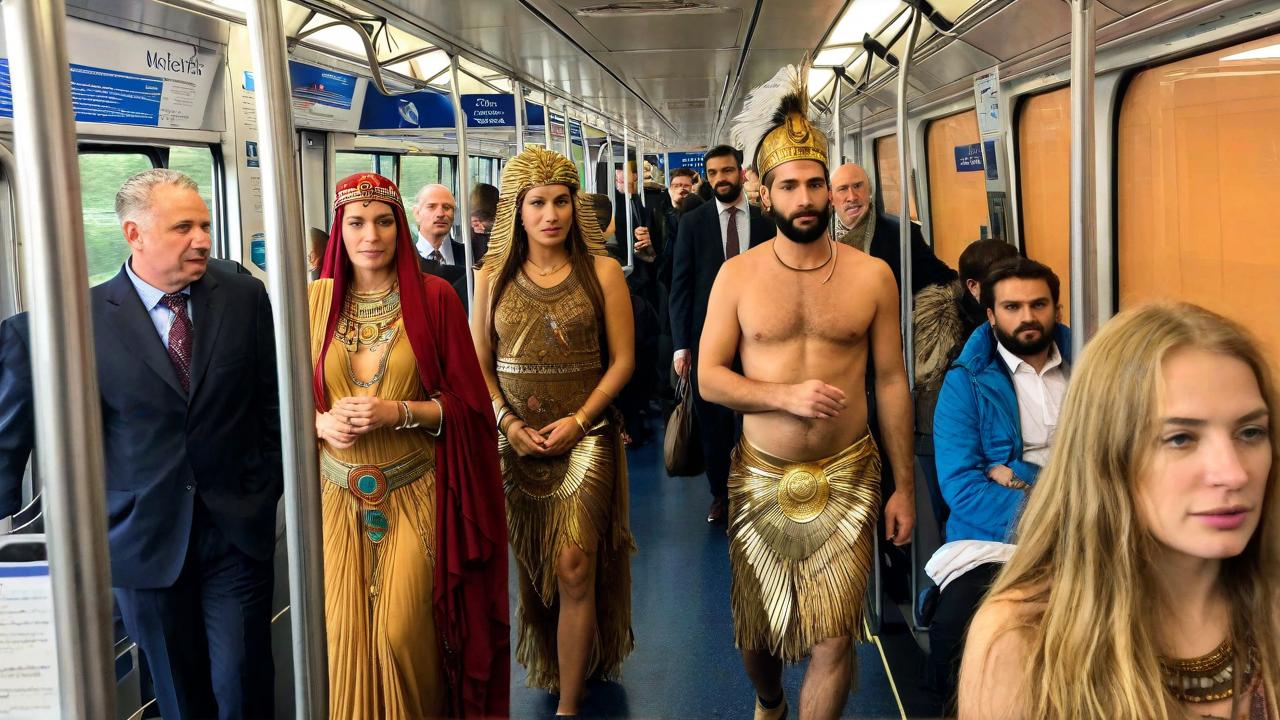
The Unconscious Enactment of Mesopotamian Deities on the Morning Commute: A Sociological Exploration
As one embarks upon the daily ritual of commuting, a peculiar phenomenon often occurs without notice or introspection. The morning commute, typically viewed as an uninspiring and mundane experience, can be influenced by an unconscious reenactment of ancient Mesopotamian mythology. This observation may strike many as incongruous, yet an examination of sociological implications reveals an intriguing narrative.
The Enigmatic Case of Gilgamesh
On a typical Monday morning, one might observe the following tableau: a young professional, clad in attire that conveys authority and productivity, hastens towards their destination with purposeful strides. As they pass by a group of fellow commuters engaged in animated conversation, it becomes apparent that their words are reminiscent of an ancient epic poem - Gilgamesh, to be specific. The young professional, unwittingly, has adopted the role of Enkidu, Gilgamesh's arch-nemesis-turned-friend.
In the epic tale of Gilgamesh, a Mesopotamian king, the protagonist is initially met with resistance and challenges by Enkidu, only to eventually form an unbreakable bond. As our commuter hastens towards their office, it becomes evident that they have internalized this narrative, adopting the tenets of Enkidu - unrelenting determination, fierce competitiveness, and a strong desire for validation.
The Sumerian Trilby: A Symbolic Expression of Social Status
During another morning commute, an individual dons a distinctive hat style, eerily reminiscent of the Sumerian goddess, Ishtar. The trilby, a fedora-like chapeau, is often viewed as an unassuming fashion accessory; however, its presence signals the presence of a particular archetype - one who embodies the essence of feminine power.
In ancient Mesopotamia, Ishtar was revered for her capacity to regulate fertility and ensure the cycles of nature. As our commuter wears this symbolic hat, they unwittingly tap into the feminine divine, exhibiting an unconscious desire for nurturing and fertility - a trait that resonates deeply with their own emotional psyche.
The Epic Struggle Between Anu and Enlil: Commuter Dynamics
One's journey to work can also be seen as a microcosm of ancient Mesopotamian celestial politics. In this regard, the dynamics between the gods Anu and Enlil serve as a useful analogy for commuter interactions.
Anu, the sky god, is often depicted as an authoritative figure, governing the cosmos with wisdom and authority. Conversely, Enlil, the air god, is frequently shown as a tumultuous force, capable of unleashing storms and whirlwinds. As our commuters navigate the crowded train carriage or bus route, they are forced to confront these opposing forces - Anu's stability and Enlil's volatility.
This struggle between order and chaos reflects the daily commuter experience: one must adapt to changing circumstances while maintaining a semblance of control and authority. By internalizing the mythological narratives surrounding Anu and Enlil, commuters may inadvertently cultivate coping mechanisms that enable them to navigate these interpersonal conflicts with greater aplomb.
The Ubiquity of Enuma Elish in Modern Life
In an era where information is at one's fingertips, it would be remiss to overlook the enduring influence of ancient Mesopotamian mythology on contemporary culture. Enuma Elish, a sacred hymn penned by the Sumerians, has had far-reaching implications for our collective psyche.
This epic poem tells the story of creation - from the primordial chaos of Nammu to the rise and fall of Marduk, the chief god of Babylon. As we embark on our daily journeys, we are often caught up in an unacknowledged narrative that resonates with these mythological themes: the struggle for power, the search for meaning, and the quest for identity.
The Mythopoeic Commuter: An Exploration of Power Dynamics
One can also argue that the commuter's unconscious reenactment of Mesopotamian mythology reveals deeper issues surrounding social dynamics and power structures. By internalizing these narratives, commuters may be perpetuating a particular archetype - one that reinforces existing societal hierarchies.
Gilgamesh, for instance, exemplifies the mythological archetype of the Strong One, who must overcome adversity to achieve triumph. This narrative echoes the notion of success as predicated upon individual strength and determination, thereby reinforcing patriarchal norms.
In contrast, Ishtar's character subverts these expectations by presenting a more fluid, adaptable feminine presence - one that blurs traditional boundaries between masculine and feminine roles. By internalizing this mythological figure, commuters can challenge their own notions of power dynamics and societal expectations.
Conclusion: The Sociological Significance of Unconscious Mesopotamian Reenactment
The phenomenon of unconscious reenactment of ancient Sumerian mythology during morning commutes serves as a window into the human psyche. By examining this aspect of our daily lives, we gain insight into the narratives that shape our thoughts, emotions, and actions.
As we continue on our journey to work, let us not overlook the Mesopotamian gods who subtly influence our daily lives - Gilgamesh's unyielding determination, Ishtar's nurturing presence, or Anu and Enlil's eternal struggle. By acknowledging these mythological undertones, we can gain a deeper understanding of ourselves and those around us.
After all, as the great Sumerian sage, Enheduanna, once penned: There is no new thing under the sun. In this sense, our morning commutes are not the first occurrence of an ancient Mesopotamian mythological narrative - merely a modern manifestation of a timeless theme that resonates deeply within us.