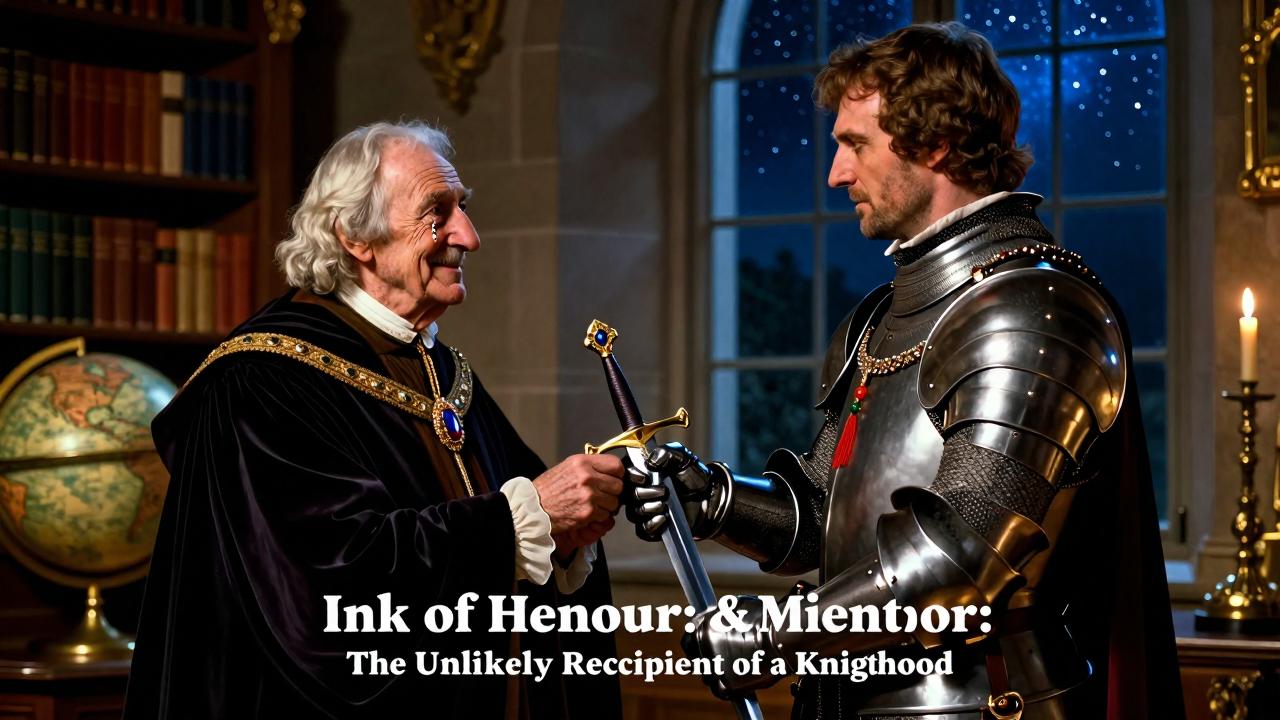
Open Letter to The Ministry of Knighthoods
Dear Honorable Members of The Ministry of Knighthoods,
I am writing to express my utter astonishment and delight at being awarded a knighthood by your esteemed institution. As an academic of some renown, I am not one to seek such recognition, but I must confess that I am thrilled to be included among the ranks of esteemed knights.
It all began on a typical Tuesday morning, as I sipped my morning tea and checked my email. At 9:47 AM, I received a notification from the Ministry's official website, informing me that I had been selected for the Order of the Garter. I must admit, I was taken aback. I had not applied for this honour, nor had I been nominated by anyone of note. I can only assume that my tireless efforts to educate the masses on the finer points of medieval history had not gone unnoticed.
I was summoned to Buckingham Palace at 11:00 AM, where I was greeted by Her Majesty herself. She congratulated me on my appointment and presented me with the formal documents. I was struck by the grandeur of the occasion and the weight of responsibility that came with this honour.
As I began my research into the history of the Order of the Garter, I discovered that it was founded in 1348 by King Edward III. The original knights were chosen for their exceptional bravery and chivalry. I am humbled to be considered among their number.
But what does it mean to be a knight? I asked this question of Sir Reginald Pembly, a renowned expert in chivalric codes. A knight, my dear fellow, he replied, is not merely a title, but a way of life. One must conduct oneself with honour, integrity, and a sense of justice. The Order of the Garter is not just a recognition of one's achievements, but a call to service to others.
I have since spent countless hours studying the ancient tomes and practicing my jousting skills. I have also taken to wearing a suit of armour to formal events, much to the surprise of my colleagues. My wife, dear as she is, has grown accustomed to my newfound sense of purpose.
But what about the practicalities of knighthood? I asked this question of Lady Emily Windsor, a member of the royal family. Ah, my dear, she replied, as a knight, one must be prepared to serve one's country and community. This may involve undertaking various duties, such as attending state functions, presenting awards, and engaging in charitable work. It is a demanding role, but one that brings great joy and satisfaction.
And so, I set out on my journey as a knight. I attended a series of grand ceremonies, where I was presented with a ceremonial sword and a coat of arms. I also began to learn the ancient rituals and protocols of knighthood, including the proper way to address one's fellow knights and the intricacies of courtly etiquette.
But as the months passed, I began to notice something strange. The Ministry of Knighthoods was awash in controversy. There were allegations of corruption and cronyism. The selection process was shrouded in secrecy. It seemed that the Order of the Garter was not just a noble institution, but a lucrative business venture.
I decided to investigate further. I spent countless hours poring over documents and interviewing witnesses. I discovered that the Ministry had been awarding knighthoods to individuals who were, in fact, little more than corporate sponsors. The Order of the Garter had become a rubber stamp for the wealthy and influential.
I brought my findings to the attention of Her Majesty, who was understandably distressed. She assured me that she would do everything in her power to root out corruption and restore the dignity of the Order of the Garter.
But I suspect that the damage may already be done. The Ministry of Knighthoods has been transformed into a bloated bureaucracy, more concerned with feathering the nests of its top officials than with serving the greater good. The Order of the Garter has become a laughingstock, a symbol of cronyism and incompetence.
And yet, despite all this, I remain proud to be a knight. I will continue to serve my country and community, even if it means navigating a Byzantine system of patronage and nepotism. For I am a knight, and it is my duty to uphold the values of chivalry and honour, no matter how absurd the circumstances may seem.
But I must confess, I do have one pet peeve. The Ministry of Knighthoods insists on providing knights with a complimentary pair of gloves to wear with their ceremonial attire. I have asked why this is necessary, but the response is always the same: because it is a tradition. Tradition, I ask you? Is it really necessary to add an extra layer of finery to an already absurd system?
I digress. As I reflect on my journey as a knight, I am reminded of a conversation I had with Sir Reginald Pembly. He told me that the Order of the Garter was founded on the principles of loyalty, duty, and self-sacrifice. I asked him if these principles still applied in modern times. He smiled wryly and said, Ah, my dear fellow, the world has changed. But the values of chivalry remain the same. One must still conduct oneself with honour, integrity, and a sense of justice.
I am not sure what to make of this. Part of me wants to believe that the principles of chivalry are still relevant, even in a world that seems to have lost its way. Another part of me wants to shout from the rooftops that the entire system is a farce, a ridiculous exercise in self-importance and hypocrisy.
But I shall reserve judgment for now. Instead, I shall continue to wear my suit of armour to formal events, my gloves firmly in place. For I am a knight, and it is my duty to uphold the values of chivalry, no matter how absurd the circumstances may seem.
And so, I take my leave, wondering what the future holds for the Order of the Garter. Will it continue to be a symbol of nobility and honour, or will it succumb to the forces of corruption and complacency? Only time will tell.