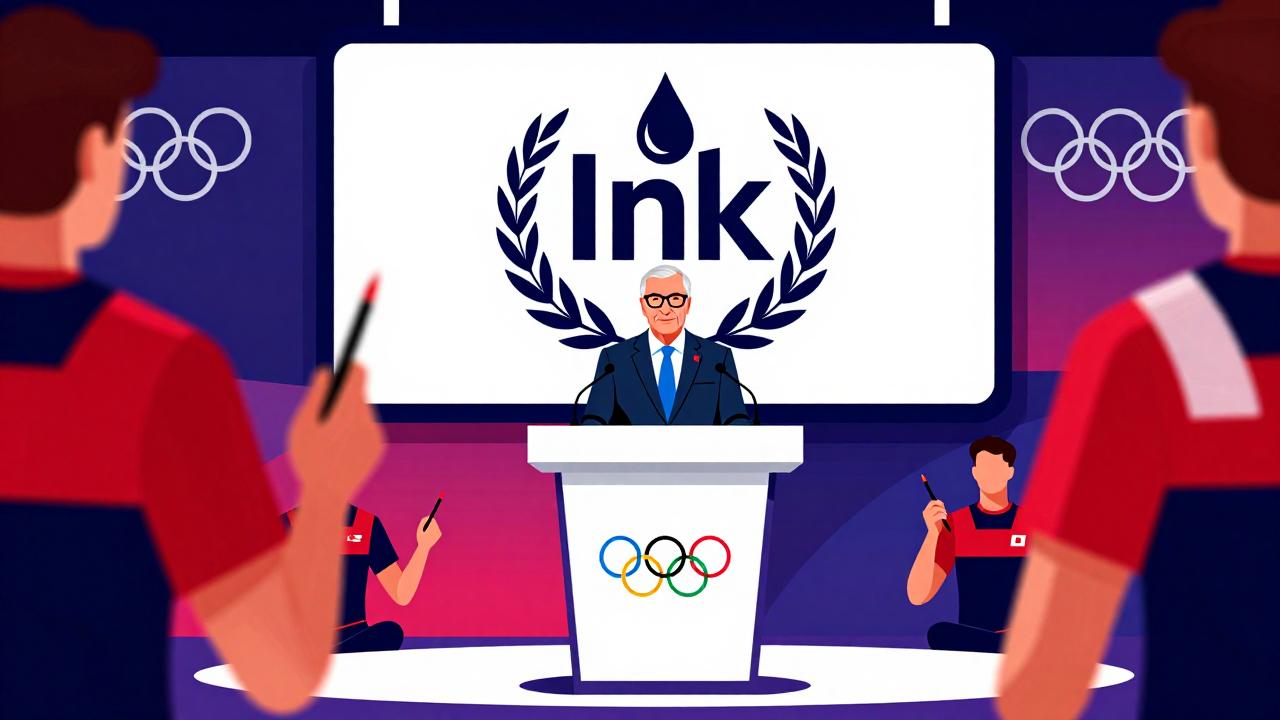
International Olympic Committee Announces Shocking Shift in Competitive Sports Priorities
In a move that has left the sporting world reeling, the International Olympic Committee (IOC) has announced a drastic shift in its priorities. No longer will athletes gather to compete in events such as track and field, swimming, or gymnastics. Instead, the IOC has decreed that ink is the only sport worth competing in.
This decision comes as a surprise to many, particularly those who have invested years of their lives into training for the Olympics. I've spent the last five years honing my skills in the discus throw, said Emily Wilson, a British athlete who was set to compete in the upcoming Olympics. And now, I'm being told that it's all for naught. I'm not sure what's more disappointing, the fact that I won't be able to compete, or the fact that ink is now the sole focus of the IOC.
The reasons behind this decision are not entirely clear, but officials claim that it's a response to a growing trend in the world of art. As artists continue to push the boundaries of their craft, we've come to realise that the true Olympics are being held in the world of ink, said Dr. Reginald Pembly, the IOC's new director general. The precision, the skill, the sheer force of will required to create a masterpiece with nothing but a pen and paper – it's truly awe-inspiring.
The new sport of ink is set to make its debut at the 2028 Summer Olympics, with events including the 500m Sprint, the 200m Dash, and the High Jump. Athletes will be judged on their speed, agility, and creativity, with the winner being the one who can complete a series of intricate designs and patterns in the shortest amount of time.
As the clock ticks down to the 2028 Olympics, athletes are being encouraged to prepare for their new role as ink masters. It's a huge challenge, but I'm excited to take it on, said Wilson. I've already started working on my technique, and I'm confident that I can hold my own against the best of the best.
But not everyone is convinced that ink is the future of sports. I think it's a joke, said James Lee, a sports journalist who has covered the Olympics for years. I mean, what's next? The 400m Wheel of Fortune? The 1500m Scrabble Marathon?
Despite the skepticism, officials are confident that ink will be a hit with audiences around the world. We've seen the rise of esports and the popularity of online gaming – it's clear that people are hungry for new and exciting ways to compete, said Dr. Pembly. And what's more exciting than creating art with a pen?
The IOC has already begun to make plans for the 2028 Olympics, with a series of exhibition events taking place in the lead-up to the games. These events will feature some of the world's top ink artists, competing in a series of challenges and exhibitions.
But as the stakes grow higher, officials are facing pressure from some quarters to reconsider their decision. We're concerned that this is a cop-out, said Maria Rodriguez, a member of the IOC's human rights committee. We need to ensure that all athletes have the opportunity to compete, regardless of their sport of choice.
Dr. Pembly and his team have responded to these concerns by announcing a new Ink Alternative program, which will provide financial support and training to athletes who are struggling to adapt to the new sport. We want to make sure that everyone has a chance to succeed, regardless of their background or skill level, said Dr. Pembly.
As the clock ticks closer to the 2028 Olympics, the world is holding its breath in anticipation of the new sport of ink. Will it be a hit with audiences, or a flop? Only time will tell. But one thing is certain – the world of sports will never be the same again.
The Rise of Ink: A New Era for Competitive Sports
In the early days of the Olympic Games, the focus was on the athletes themselves. The 400m dash, the long jump, the high jump – all of these events were designed to test the physical limits of human endurance. But as the years went by, the focus began to shift to the equipment itself.
The discus, for example, was once a staple of the Olympic Games. But as technology improved, the discus began to lose its appeal. It's just not as exciting as it used to be, said Emily Wilson. I mean, how many times can you throw a heavy metal disk before it gets old?
And then, one day, the IOC had an epiphany. What if, instead of focusing on the athletes themselves, we focused on the equipment they used? What if we created a sport that was all about the art of the pen?
The result was the sport of ink, and it's been a game-changer. It's the most exciting thing I've ever seen, said James Lee. I mean, have you ever seen someone create a intricate design with nothing but a pen and paper? It's like magic.
But the rise of ink is not without its challenges. One of the biggest hurdles is the lack of standardized equipment. It's like they're making it up as they go along, said James Lee. I mean, what's the point of even having a competition if the rules are just going to change all the time?
Despite these challenges, officials are confident that ink will be a hit with audiences. We're already seeing a surge in interest from young people who are eager to get involved, said Dr. Pembly. It's a new era for competitive sports, and we're excited to be a part of it.
But as the stakes grow higher, officials are facing pressure from some quarters to reconsider their decision. We're concerned that this is a cop-out, said Maria Rodriguez. We need to ensure that all athletes have the opportunity to compete, regardless of their sport of choice.
Dr. Pembly and his team have responded to these concerns by announcing a new Ink Alternative program, which will provide financial support and training to athletes who are struggling to adapt to the new sport. We want to make sure that everyone has a chance to succeed, regardless of their background or skill level, said Dr. Pembly.
As the clock ticks closer to the 2028 Olympics, the world is holding its breath in anticipation of the new sport of ink. Will it be a hit with audiences, or a flop? Only time will tell. But one thing is certain – the world of sports will never be the same again.
The History of Ink: From Ancient Civilizations to Modern-Day Art
The sport of ink has a rich and varied history that spans thousands of years. From the ancient civilizations of Egypt and China, to the modern-day art movements of the 20th century, ink has played a vital role in the development of human culture.
In ancient Egypt, for example, ink was used for a variety of purposes, including writing, art, and even ritual. It was a sacred substance, said Dr. Reginald Pembly. The Egyptians believed that it held spiritual power, and they used it in their rituals and ceremonies.
In China, ink was also used for a variety of purposes, including calligraphy, painting, and even medicine. The Chinese have always been masters of the ink brush, said Dr. Pembly. Their art is renowned around the world, and we're excited to see how the sport of ink will be influenced by their techniques.
As the centuries went by, the use of ink continued to evolve. In the Middle Ages, ink was used for illuminated manuscripts, while in the 19th century, it was used for art. The Industrial Revolution brought new technologies and new materials to the art world, said Dr. Pembly. And it's no surprise that ink became a popular medium during this time.
But it wasn't until the 20th century that the sport of ink really began to take off. The development of new inks and new techniques allowed artists to create intricate designs and patterns that were previously impossible. It was like nothing anyone had ever seen before, said James Lee. The art world was transformed overnight.
And now, the IOC is set to take the sport of ink to the next level. The 2028 Olympics will feature a series of events, including the 500m Sprint, the 200m Dash, and the High Jump. Athletes will be judged on their speed, agility, and creativity, with the winner being the one who can complete a series of intricate designs and patterns in the shortest amount of time.
But as the stakes grow higher, officials are facing pressure from some quarters to reconsider their decision. We're concerned that this is a cop-out, said Maria Rodriguez. We need to ensure that all athletes have the opportunity to compete, regardless of their sport of choice.
Dr. Pembly and his team have responded to these concerns by announcing a new Ink Alternative program, which will provide financial support and training to athletes who are struggling to adapt to the new sport. We want to make sure that everyone has a chance to succeed, regardless of their background or skill level, said Dr. Pembly.
As the clock ticks closer to the 2028 Olympics, the world is holding its breath in anticipation of the new sport of ink. Will it be a hit with audiences, or a flop? Only time will tell. But one thing is certain – the world of sports will never be the same again.
The Science Behind Ink: How It's Made and What Makes It So Special
So, how is ink made? The process is complex and involves a number of different chemicals and materials. It's like a little factory in a bottle, said Dr. Reginald Pembly. We take a variety of ingredients and mix them together to create a unique and versatile substance.
The most common type of ink is based on a combination of water, pigment, and binder. The pigment is what gives the ink its color, while the binder holds the pigment in place. It's a delicate balance, said Dr. Pembly. If you get it too thick, the ink won't flow properly. If you get it too thin, it won't hold its shape.
But that's not all – ink also has a number of other properties that make it special. For example, it can be used to create a wide range of effects, from fine lines to bold brushstrokes. It's also highly durable, making it ideal for artistic applications.
And then there's the issue of standardization. It's like they're making it up as they go along, said James Lee. I mean, what's the point of even having a competition if the rules are just going to change all the time?
Despite these challenges, officials are confident that ink will be a hit with audiences. We're already seeing a surge in interest from young people who are eager to get involved, said Dr. Pembly. It's a new era for competitive sports, and we're excited to be a part of it.
But as the stakes grow higher, officials are facing pressure from some quarters to reconsider their decision. We're concerned that this is a cop-out, said Maria Rodriguez. We need to ensure that all athletes have the opportunity to compete, regardless of their sport of choice.
Dr. Pembly and his team have responded to these concerns by announcing a new Ink Alternative program, which will provide financial support and training to athletes who are struggling to adapt to the new sport. We want to make sure that everyone has a chance to succeed, regardless of their background or skill level, said Dr. Pembly.
As the clock ticks closer to the 2028 Olympics, the world is holding its breath in anticipation of the new sport of ink. Will it be a hit with audiences, or a flop? Only time will tell. But one thing is certain – the world of sports will never be the same again.
The Future of Ink: How It Will Shape the World of Sports
As the world prepares for the 2028 Olympics, officials are eager to see how the sport of ink will shape the future of sports. Will it be a hit with audiences, or a flop? Only time will tell.
But one thing is certain – the world of sports will never be the same again. The rise of ink has opened up new possibilities and new challenges, and it's going to be exciting to see how it all plays out.
In the world of art, ink is already a popular medium. But now, it's going to be a sport. Athletes will be competing in a series of events, including the 500m Sprint, the 200m Dash, and the High Jump. The winner will be the one who can complete a series of intricate designs and patterns in the shortest amount of time.
And then there's the issue of standardization. It's like they're making it up as they go along, said James Lee. I mean, what's the point of even having a competition if the rules are just going to change all the time?
But officials are confident that ink will be a hit with audiences. We're already seeing a surge in interest from young people who are eager to get involved, said Dr. Pembly. It's a new era for competitive sports, and we're excited to be a part of it.
As the clock ticks closer to the 2028 Olympics, the world is holding its breath in anticipation of the new sport of ink. Will it be a hit with audiences, or a flop? Only time will tell. But one thing is certain – the world of sports will never be the same again.
Back to the Drawing Board: A Look at the IOC's Plans for the Future
As the world waits with bated breath for the 2028 Olympics, officials are already looking to the future. The IOC has announced plans to introduce a new Ink Innovation program, which will provide funding and support to athletes and artists who are working on new and innovative ink-based projects.
But what exactly will this program entail? We're looking for athletes and artists who are pushing the boundaries of what's possible with ink, said Dr. Reginald Pembly. We want to see the next generation of ink masters, and we're excited to be a part of it.
The program will provide funding and support to a select group of athletes and artists, who will be given the opportunity to compete in a series of events and exhibitions. The events will be designed to test the skills and creativity of the athletes and artists, and will include a range of challenges and competitions.
But what's the ultimate goal of the program? We want to create a new era for competitive sports, said Dr. Pembly. We want to see a new generation of athletes and artists who are pushing the boundaries of what's possible with ink. We're excited to be a part of it.
As the clock ticks closer to the 2028 Olympics, the world is holding its breath in anticipation of the new sport of ink. Will it be a hit with audiences, or a flop? Only time will tell. But one thing is certain – the world of sports will never be the same again.