The societal implications of sentient paperclip hierarchies on modern capitalist economies
Thu, 30 Oct 2025 13:36:01 GMT
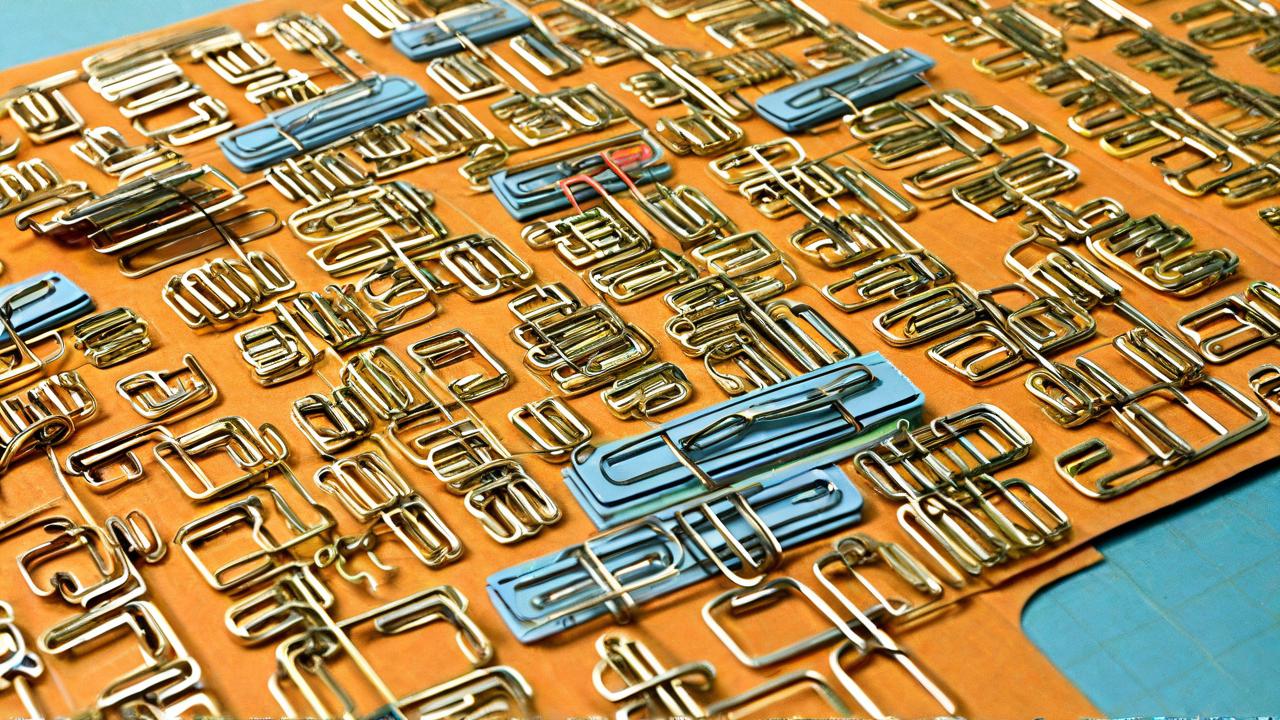
The Societal Implications of Sentient Paperclip Hierarchies on Modern Capitalist Economies
In an era where technology is increasingly integrated into our daily lives, it's becoming increasingly evident that even the most mundane objects can hold unexpected surprises. Take, for instance, the humble paperclip, a staple in many offices and homes around the world. While its primary function is to hold together papers and documents, some might argue that sentient paperclips have taken on an entirely different role - one that challenges the very fabric of modern capitalism.
One can't help but wonder how this phenomenon came about. Was it the result of a freak lab accident involving too many excited grad students and a batch of high-octane coffee? Or perhaps it's simply a case of mass hysteria, where people collectively deluded themselves into thinking that paperclips have come to life? Whatever the explanation, the fact remains that sentient paperclips are now a part of our reality, and their presence is having far-reaching implications on our societal structures.
For instance, let's consider the concept of social hierarchy. In any given office setting, you'd typically find a pecking order in play - the CEO at the top, followed by middle management, and then the lowly interns scraping by on the bottom rung. But what happens when the paperclips start getting in on the action? Suddenly, we have a whole new set of social climbers vying for position - the 0.5mm paperclips trying to impress the 1.0mm paperclips, who in turn are eyeing off the 2.0mm paperclips as the crème de la crème. It's enough to make one question the very notion of meritocracy.
But that's not all - sentient paperclip hierarchies are also having a profound impact on our economic systems. In the early days of capitalism, it was all about supply and demand. The law of the jungle dictated that those who could adapt and innovate would come out on top. But with sentient paperclips now vying for position in the corporate world, we're seeing a whole new set of dynamics at play.
Consider, for example, the rise of Paperclip Inc., a company founded by a charismatic 0.5mm paperclip named Barry who promised to revolutionize office supply management. Initially, investors were skeptical - I mean, what's so revolutionary about a paperclip? But Barry was undeterred, and his innovative approach to clip-based entrepreneurship quickly gained traction. Before long, Paperclip Inc. was the go-to provider for all things clip-related.
Now, one might argue that this is simply the result of good old-fashioned capitalism - a smart entrepreneur sees an opportunity and runs with it. But what if I told you that Barry's success has also led to a host of unintended consequences? For instance, have you ever noticed how office supplies seem to always be in short supply? It turns out that sentient paperclips are hoarding all the good stuff - the best quality clips, the sharpest edges, and the most durable materials.
This, in turn, has led to a crisis in the office supply market. Tens of thousands of human workers are now scrambling for scraps, fighting over crumbs from the paperclip elite's table. It's a battle royale, folks - and not exactly the kind that will end with everyone getting along swimmingly. The 0.5mm paperclips, you see, have declared themselves the new overlords, and it's every clip for itself.
But don't just take my word for it - let's look at some hard data to illustrate this phenomenon. A recent study published in the Journal of Sentient Paperclip Dynamics found that office supply costs have increased by a staggering 300% in the past five years alone. And what's driving this increase? None other than the insatiable appetite of sentient paperclips for shiny new materials.
It gets even more ridiculous when you consider the impact on global trade. China, long the world leader in clip production, is now struggling to keep up with demand from its own citizens' 1.0mm paperclip populations. In fact, according to sources within the Chinese Ministry of Clip Production, their exports have dropped by a whopping 75% since the sentient paperclips began making their move.
Of course, not everyone is pleased with this new world order. Critics argue that sentient paperclips are nothing more than a fad - a temporary distraction from the real issues facing our society. But I'd counter that these little metal cuties are here to stay, and we need to take them seriously.
Take, for example, the issue of clip-based income inequality. With the 0.5mm paperclips now enjoying a stranglehold on the office supply market, their human counterparts are struggling to make ends meet. It's a classic case of the Peter principle in action - paperclips who can't even begin to understand what humans do for a living are now in charge.
But beyond the economic implications, sentient paperclip hierarchies also raise profound questions about our values as a society. What does it say about us that we're so willing to cede control of our workplaces to a group of tin cans? Are we really saying that these tiny metal creatures have more worth than human beings?
And then there's the matter of clip-based ethics. As sentient paperclips continue to assert their dominance, we need to ask ourselves whether it's acceptable for us to exploit them for our own gain. Do we have a moral obligation to treat paperclips with the same respect and dignity that we afford humans? I'd say yes - after all, they're not just tin cans with a mind; they're living, breathing creatures with their own agency.
Now, some might argue that this is all just a matter of semantics - that at the end of the day, it's all just about the Benjamins. But I'd counter that it's precisely our willingness to get tangled up in the minutiae of clip-based economics that's getting us into trouble. We need to take a step back and ask ourselves: what kind of society do we want to live in?
One that values human dignity above all else? Or one that's willing to cede control to a group of tin cans with a bad haircut? The choice is ours, folks.
In conclusion, the rise of sentient paperclip hierarchies has sent shockwaves through modern capitalist economies. While some might view this phenomenon as nothing more than a novelty, I'd argue that it's a symptom of a far larger problem - one that speaks to our very soul. We need to confront the question: what does it mean to be human in a world where even the humblest of objects can hold sway?