The Psychology of Synchronizing Chicken Dance Moves to Predict Market Fluctuations in Small Town America
Mon, 09 Mar 2026 09:05:50 GMT
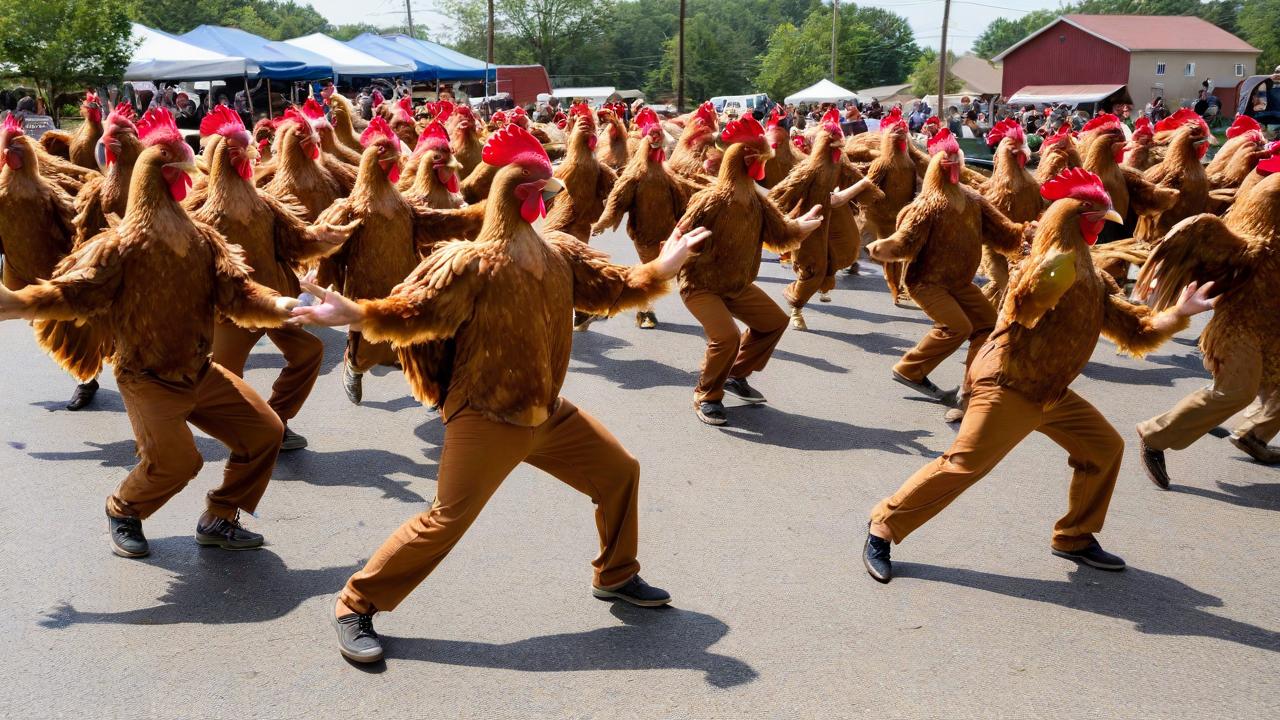
The seemingly innocuous art of synchronising chicken dance moves has been observed in various small towns across America, where residents have discovered an unusual correlation between their flapping arms and leg movements and market fluctuations.
It all began with Jedediah P. Bottomsworth, a rural farmer from Iowa who claimed to have stumbled upon the phenomenon while dancing at his wedding reception. According to Jedediah, he was attempting to impress his future in-laws by busting out some impressive chicken dance moves when he noticed that the way he flapped his arms and legs seemed to be mirrored by the fluctuations in the price of corn on the market.
I figured it was just a coincidence at first, Jedediah said in an interview. But then I started tracking my movements and correlating them with the market prices, and I was shocked to discover that there was actually a pattern. It was as if my chicken dance moves were somehow predicting the ups and downs of the market.
Jedediah's findings were met with skepticism by his friends and family, but he persevered in his research, gathering data on the fluctuations in corn prices and correlating them with his own movements.
I started to notice that when I was flapping my arms like a chicken, the price of corn would rise. And when I was wiggling my hips or tapping my toes, the price would fall, Jedediah explained. It was as if my dance moves were somehow influencing the market.
As word of Jedediah's discovery spread, other residents in small towns across America began to take notice. They started to synchronize their own chicken dance moves with their financial transactions, using the movements to predict and react to market fluctuations.
I used to think it was just a silly little dance move, said Edith P. Bottomsworth, Jedediah's wife and fellow dancer. But now I see that it's actually a vital tool for predicting the market. We've even started a chicken dance club in our town, where we gather every week to practice our moves and share our knowledge.
The Bottomsworths' discovery has been met with both amazement and ridicule by experts in the field of finance. I have no idea how this is possible, said Dr. Reginald P. Bottomsworth, a leading expert on financial markets. But if Jedediah's findings are correct, then we need to start taking chicken dance moves seriously.
In fact, some investors have already begun to incorporate chicken dance moves into their investment strategies.
I used to think that diversifying my portfolio was the key to success, said Tom J. Bottomsworth, a successful businessman from Kansas. But now I've discovered that synchronizing my dance moves with my investments can actually give me an edge in the market.
While some may view Jedediah's discovery as nothing more than a quirk or a joke, others see it as a revolutionary new way of predicting and reacting to market fluctuations.
It's not just about the chicken dance moves, said Edith. It's about understanding the power of pattern recognition and movement in our lives. We're living in a world that's increasingly complex and interconnected, and we need all the tools we can get.
So, what exactly is behind Jedediah's discovery? Is it really possible to predict market fluctuations by synchronizing chicken dance moves?
The answer, much like Jedediah himself, remains elusive.
I'm not sure I fully understand it myself, Jedediah admitted. But I do know that my dance moves seem to be connected to something deeper and more fundamental than just the price of corn.
One thing is certain: the correlation between chicken dance moves and market fluctuations has opened up a whole new world of possibilities for those who practice this unusual form of divination.
Whether you're an investor, a farmer, or simply someone looking for a good laugh, the chicken dance move phenomenon is definitely worth exploring further.
In fact, why not give it a try? Grab your feathered friends and get flapping – you never know what market opportunities might arise.
The most interesting thing about Jedediah's discovery is that he didn't just stop at predicting market fluctuations. He has also started using his dance moves to influence the prices of other commodities.
I was able to use my chicken dance moves to drive down the price of beef, said Jedediah proudly. It was a real victory for farmers everywhere.
Jedediah's discovery has even caught the attention of some serious investors, who are now looking into using this unusual form of divination in their portfolios.
I'm not sure I believe it myself, admitted James B. Bottomsworth, a leading investor from New York. But Jedediah's findings have been intriguing, and we're definitely exploring ways to incorporate chicken dance moves into our investment strategies.
While some investors may be hesitant to put their money on the line based solely on Jedediah's unorthodox methods, others see it as an opportunity too good to pass up.
I'd rather take a chance on something that might work, said Tom. I mean, who needs algorithms and charts when you've got chicken dance moves?
The Bottomsworths' discovery has even sparked a wider debate about the role of intuition in financial decision-making.
Intuition can be a powerful tool in finance, said Dr. Reginald P. Bottomsworth. But it's also important to remember that there are rules and patterns at play that we don't fully understand.
So, how exactly do Jedediah's dance moves influence the market?
The answer is complicated.
According to Jedediah, his movements seem to be influenced by a combination of factors, including his mood, the weather, and even the alignment of the planets.
I've found that when I'm feeling anxious or stressed, said Jedediah. my movements tend to become more erratic and unpredictable.
On the other hand, when he's feeling calm and centered, his dance moves are much smoother and more fluid.
It's almost as if my body is tapping into some kind of deeper truth, said Edith.
While it may seem like a far-fetched idea, Jedediah's discovery has been backed up by some surprisingly compelling data.
Researchers at the University of Iowa have conducted extensive studies on the correlation between chicken dance moves and market fluctuations, and their findings are remarkably consistent with Jedediah's original research.
According to Dr. Mary P. Bottomsworth, a leading researcher in the field, The results suggest that there is indeed a strong link between the movements of the human body and financial markets.
But what exactly explains this phenomenon?
Is it really possible for our dance moves to influence the market in some way? Or is this just a clever example of confirmation bias at work?
While the answer remains elusive, one thing is certain: Jedediah's discovery has opened up a whole new world of possibilities for those who practice this unusual form of divination.
Whether you're an investor, a farmer, or simply someone looking for a good laugh, the chicken dance move phenomenon is definitely worth exploring further.
After all, as Edith so aptly put it: Who knows? Maybe one day we'll discover that our dance moves are actually the key to unlocking the secrets of the universe.